
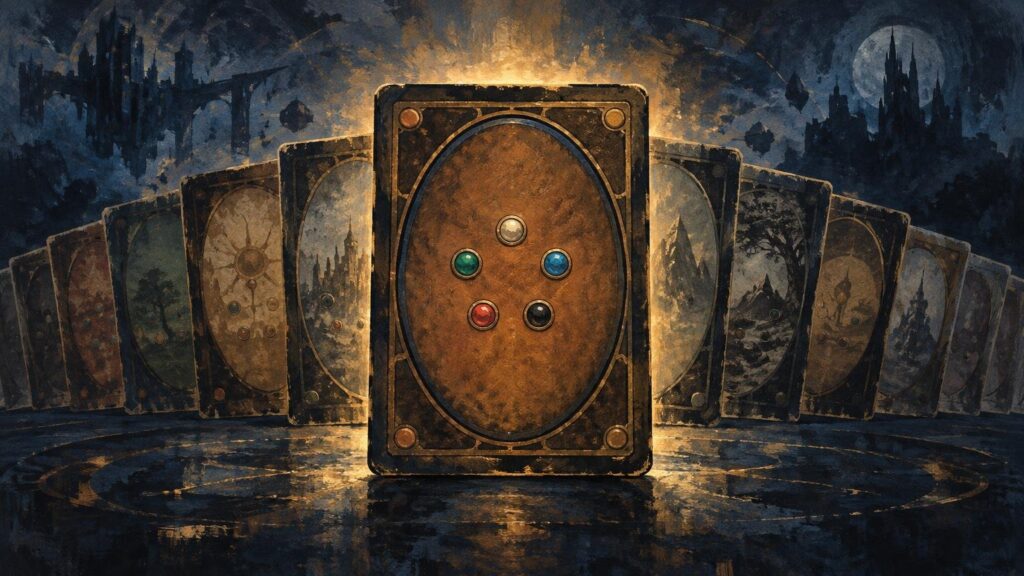
TLDR: The familiar Magic card back has survived because consistency is functionally valuable. Cards from different sets and decades can be shuffled together without their backs revealing which card is which. Its brown frame, five colored orbs, old blue logo, and Deckmaster label are artifacts of Magic’s beginnings, but conventional single-faced cards still preserve that visual identity. Double-faced cards and special collector products are important exceptions.
The most interesting part of MTG card back history is that the design was not originally intended to belong exclusively to Magic. “Deckmaster” was conceived as an umbrella brand for multiple trading card games. Those larger plans faded, but the label remained on the back of one of the world’s longest-running card games.
That makes the back a small piece of 1993 preserved in active use. Card fronts have moved through the old border, the modern frame, the M15 frame, showcase treatments, and many experimental layouts. You can follow those changes in this history of MTG card frames. The conventional back, by contrast, continues to connect cards from widely separated eras.
What is the classic MTG card back supposed to depict?
Wizards has described the card back as a magic tome containing a player’s library of spells. That interpretation connects the physical deck to Magic’s original fiction: the cards are the spells and resources available to the dueling mage.
The design presents that tome through a dark brown border, a central oval holding the blue Magic: The Gathering logo, five colored orbs, and the word “Deckmaster” below. The orbs correspond visually to Magic’s five colors, but there is little benefit in assigning elaborate symbolism to every line, shadow, or fleck. Some details may simply be parts of a graphic created for a trading card in the early 1990s.
The back also preserves an older version of the Magic logo. Wizards has repeatedly modernized the branding used on packaging, websites, card fronts, and promotional materials. In an October 8, 2017 brand-refresh announcement, however, the company specifically treated the paper card back as an exception and said it had no plans to change it at that time. That was a dated statement rather than an irrevocable promise, but it captures why the legacy logo remained after the forward-facing brand changed.
Why does it still say Deckmaster?
Deckmaster was intended to connect several Wizards trading card games under one shared identity. Wizards has named Magic, Netrunner, and Jyhad—later renamed Vampire: The Eternal Struggle—as games associated with the brand. It was a label for a broader product family, not a subtype, format, expansion, or game mechanic.
Once that umbrella strategy stopped being important, Wizards could theoretically have removed the word. In practice, changing the back would have created a new problem without improving gameplay. A card with a visibly different reverse can disclose information while it sits in a player’s hand or library. Even a subtle redesign would require opaque sleeves whenever old and new cards appeared together.
Keeping Deckmaster was therefore easier than replacing it. The word may now look mysterious, but it does not affect how a card is read or played. For the functional information on the front—including mana cost, type line, rules text, and set details—see how to read a Magic card.
The practical reason the MTG card back history matters
A common back protects hidden information. If one expansion had a red reverse and another had a blue reverse, an opponent could identify a card’s expansion before seeing its face. In some decks, that would narrow its identity dramatically. A stable back lets cards from different releases share a shuffled library without their sets being apparent from the reverse.
Wizards has connected preservation of the paper back with both visual continuity and the ability to collect and shuffle cards from different sets and eras together. The card stock itself has also been tied to Magic’s origins: Wizards describes its primary playing-card-board specification as dating to 1993.
This does not mean every card produced since 1993 has an identical appearance, material, or printing character. Print location, age, wear, manufacturing variation, and specialized products can all matter. The narrower point is that the conventional back provides a shared visual standard for ordinary single-faced cards.
Arabian Nights nearly broke the pattern
The first expansion presented Wizards with an early decision about whether every release should share that standard. According to Wizards, Arabian Nights was initially planned with a distinct card back. The proposal was stopped before the expansion went to print.
Had that plan survived, cards from Arabian Nights would have been identifiable from the back unless players used opaque sleeves. More importantly, separate backs might have encouraged Magic expansions to operate like visually distinct games or self-contained decks. Preserving the original back reinforced the idea that new releases belonged to one interoperable card pool.
That abandoned proposal helps explain why the unchanged design is more than nostalgia. The decision made expansion cards easier to mix with the original game. Magic could transform its front-facing design while retaining a stable reverse that told players, in effect, “this belongs in the same deck system.”
Not every Magic card has the conventional back
“Magic cards all have the same back” is a useful shortcut, but it is not literally universal. Double-faced cards have a playable face on each side instead of the conventional Magic reverse. Wizards’ Kaldheim release notes explain that players can use substitute cards, opaque sleeves, or both to keep these cards indistinguishable while they are in hidden zones.
| Card or product type | What appears on the reverse | Practical consideration |
|---|---|---|
| Conventional single-faced card | The familiar Magic and Deckmaster design | Normally mixes visually with cards from other eras |
| Double-faced card | A second card face | Use an appropriate substitute card, opaque sleeves, or both to preserve hidden information |
| Collector’s Edition card | A visibly nonstandard collector presentation with gold-bordered treatment and square corners | Do not identify or value it from one feature alone |
A substitute card represents the double-faced card while it is in a hidden zone; the actual card must still be available when needed. The key issue is not that a double-faced card is somehow less real. It is that its physical construction requires a method for preventing the reverse face from revealing its identity.
Unofficial playtest cards are another distinct category. They should be presented transparently rather than made to pass as authentic cards. Players moving from a deck list to physical stand-ins can explore printing clearly identified MTG playtest cards, while the broader distinction between official cards, proxies, and counterfeits is covered in proxy cards versus real cards.
Collector’s Edition backs and the limits of visual identification
Collector’s Edition is a useful warning against assuming that every unusual-looking Magic card is counterfeit. Wizards described these cards as square-cut, gold-bordered versions of the Beta card list. It also warned that examples had been altered to resemble more valuable Beta cards.
Square corners or an unusual back can therefore be clues about what a card might be, but no single visual trait supplies a complete verdict. A card’s printing, cut, border, surface, dimensions, provenance, and signs of alteration may all matter. Historical anti-fraud advice is also not a substitute for current professional authentication.
The same caution applies to tournament use. Authenticity, product identity, collectibility, and sanctioned-play legality are separate questions. An authentic commemorative card is not automatically permitted in every event, while a legal card may still require opaque sleeves because of wear or visual differences. For a valuable purchase or sanctioned event, verify the exact card and current policy rather than relying on its back alone.
Is the blue detail near Deckmaster an accidental pen mark?
One of the card back’s smallest details has generated one of its most persistent stories. A blue shape near the Deckmaster area is often described as an accidental pen stroke or stray mark that made it into the final design. That explanation should not be repeated as settled fact.
In an interview with original Magic art director Jesper Myrfors, Myrfors said Christopher Rush created the outline around the “Magic: The Gathering” lettering, while Myrfors produced the rest of the back design and colored the words. He also disputed the popular claim that the blue detail was an accidental pen mark.
The careful conclusion is not that every mystery has been resolved. It is that the familiar accident story conflicts with the attributed account of a person directly involved in creating the design. Calling the detail “the famous blue mark” is fair; confidently calling it a printing mistake or stray pen line is not.
Why the old back still works
Magic’s card back has lasted because its age is less important than its consistency. Deckmaster no longer performs its intended umbrella-brand role, and the blue logo belongs to an earlier visual era. Yet replacing either element would weaken the continuity that lets a new card and a decades-old card look at home in the same face-down library.
The useful distinction is between the standard and its exceptions. Conventional single-faced paper cards preserve the familiar design; double-faced cards need sleeves or substitute-card handling; collector products may use deliberately different physical features; and an unusual reverse does not, by itself, prove authenticity, value, or legality. That combination of history and practical compatibility is why the back still looks like a 1993 artifact—and why changing it has rarely been worth the cost.