
TLDR
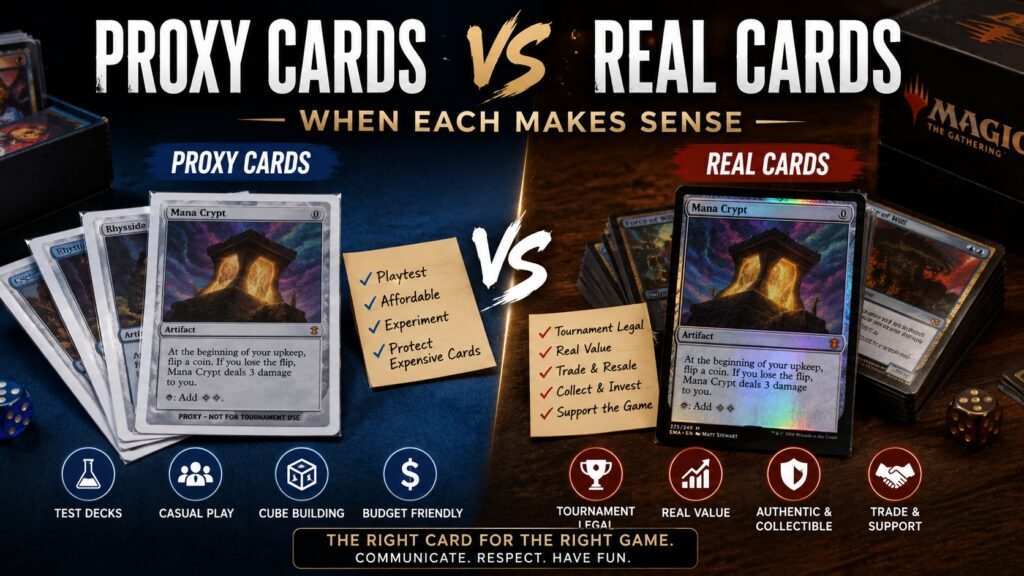
Proxy cards make sense when you want to playtest decks, build casual Commander lists, protect expensive cards, design a cube, or enjoy powerful cards without paying real-card prices.
Real cards make sense when you need tournament legality, trade value, collection value, authenticity, or long-term ownership.
The best answer is not “always proxy” or “never proxy.” Use proxy cards when access and testing matter. Use real cards when official play, collecting, and resale matter.
The Real Answer Depends on the Table
Proxy cards vs real cards is one of the most common arguments in Magic, and most of the heat comes from people talking about different situations.
A sanctioned Modern event at a local game store is not the same as a casual Commander night at your kitchen table. A cube draft with friends is not the same as trading for a real dual land. Testing a new deck for two weeks is not the same as building a collection you want to keep for years.
That is the key point: proxy cards and real cards solve different problems.
Proxy cards help people play more Magic. Real cards are the official collectible game pieces. Both can matter. The trick is knowing when each one makes sense and being clear with the people you play with.
What Are Proxy Cards?
Proxy cards are stand-ins for real Magic cards.
That can mean a lot of things. A proxy might be a basic land with “Rhystic Study” written on it. It might be a paper printout sleeved in front of a bulk card. It might be a custom card made for a cube. It might be a clean, readable proxy ordered from a dedicated proxy seller like Proxy King.
The purpose is usually simple: represent a real card during casual play or testing.
Proxy cards are commonly used for:
- Playtesting decks before buying cards
- Casual Commander games
- Kitchen table Magic
- Cube drafts
- Protecting expensive originals
- Trying Reserved List staples
- Testing mana bases
- Building budget-friendly versions of expensive decks
- Keeping multiple Commander decks playable without moving one real card around
A proxy should never be used to trick someone. That line matters. A proxy is a stand-in. A counterfeit is an attempt to pass something off as real.
That distinction keeps the conversation cleaner.
What Are Real Cards?
Real cards are authentic Magic cards printed and released by Wizards of the Coast.
They matter because they are the official game pieces. They are legal in sanctioned events when they meet the tournament requirements. They can be bought, sold, traded, collected, graded, signed, stored, and used as part of a real collection.
Real cards make sense when you care about:
- Sanctioned tournament play
- Local store event rules
- Trade value
- Resale value
- Collecting
- Authenticity
- Long-term ownership
- Supporting stores and official products
- Owning the actual version of a card you love
There is also a personal side to real cards. A real copy of a card can carry history. Maybe you opened it in a draft. Maybe you traded for it years ago. Maybe it has been in your favorite Commander deck since the beginning.
A proxy can play the same game role. But it does not replace the feeling or value of owning the real card.
When Proxy Cards Make Sense
Proxy cards make the most sense when the goal is access, testing, or casual play.
Magic is expensive in some places. Commander staples, strong mana bases, Reserved List cards, old foils, and multi-format staples can add up fast. Proxies give players room to test and enjoy the game without turning every deck idea into a financial decision.
That is a good thing when handled honestly.
Use Proxies for Playtesting
Playtesting is probably the cleanest reason to use proxy cards.
Before buying a stack of expensive singles, you can proxy the deck and see how it actually plays. This helps with Commander, Modern, Legacy, Vintage-style testing, cube design, and any brew that looks better on paper than it may feel in real games.
A card can look perfect in a decklist and still disappoint in play. Maybe it costs too much mana. Maybe it does not line up with your local meta. Maybe the deck is strong but boring. Maybe the mana base needs work.
Proxy first. Test. Adjust. Then buy the real cards that are worth owning.
This saves money and leads to better deckbuilding.
For players who want cleaner test cards than handwritten slips, Proxy King are a practical option for casual decks, playtesting, cube projects, and Commander brewing.
Use Proxies for Casual Commander
Commander is where proxy cards often make the biggest difference.
A Commander table can include players with very different budgets. One player may own fetch lands, shock lands, tutors, fast mana, and old staples. Another player may be upgrading a precon slowly. Without some flexibility, budget can become a bigger factor than deckbuilding skill or table balance.
Proxy cards can help close that gap.
But proxies should match the table’s expected power level. If everyone is playing relaxed mid-power decks, proxying a stack of cEDH staples and pubstomping the table is not the point. That is not a proxy problem. That is a social problem.
A good Commander proxy rule sounds like this:
- Proxies are fine if the deck stays near the agreed power level.
- Proxies are fine for testing.
- Proxies are fine for expensive lands and staples.
- Proxies should be readable.
- Proxies should be mentioned before the game starts.
- Proxies should not be used to mislead people about deck strength.
That keeps the game smoother.
Use Proxies for Cube
Cube is one of the best formats for proxy cards.
A cube is a custom draft environment. The cube owner chooses the cards, controls the experience, and builds the format around a specific vision. That might mean a powered vintage cube, a budget cube, a Commander cube, a set cube, or a custom theme.
Proxies let cube owners include cards that would be too expensive or risky to shuffle.
That includes cards like:
- Black Lotus
- Mox Sapphire
- Mox Jet
- Mox Pearl
- Mox Ruby
- Mox Emerald
- Ancestral Recall
- Time Walk
- Gaea’s Cradle
- The Tabernacle at Pendrell Vale
- Original dual lands
Most cube players care less about whether the card has market value and more about whether the draft is fun. Clean proxies can make the cube better without putting thousands of dollars of cardboard at risk.
This is also where higher-quality printed proxies make sense. A cube gets shuffled, drafted, sorted, and replayed often. Paper slips can work for a night. A cleaner option from Proxy King makes more sense for a cube you plan to keep using.
Use Proxies to Protect Expensive Cards
Some players own the real cards but do not want to shuffle them every week.
That is reasonable. Expensive cards can get damaged. Older cards can be fragile. High-end foils can curl. Reserved List cards can be expensive enough that even normal play feels uncomfortable.
In casual settings, some groups allow a “binder copy” approach. The player owns the real card and keeps it safe, while a proxy goes in the deck.
This is especially common for old lands, Reserved List cards, and expensive Commander staples.
The key is transparency. Tell the table what you are doing. Keep the proxy readable. Do not use the proxy in places where it is not allowed.
Use Proxies to Make Magic More Accessible
This is the heart of the proxy argument.
Magic is a better game when people can actually play it. Proxy cards can help newer players test stronger decks, help budget players join higher-powered pods, and help long-time players experiment without buying every card immediately.
That does not mean every card in every deck should be proxied forever. It means proxy cards can remove friction.
For players who want cleaner, more readable playtest cards than paper slips, Proxy King is a practical option. Their MTG proxy cards are useful for casual decks, cube drafts, Commander testing, and kitchen table play where readability matters.
A sticky note might work for one quick game. It gets old fast when people have to ask what the card does every turn.
When Real Cards Make Sense
Real cards make sense when authenticity, legality, value, or long-term ownership matters.
Proxies are practical. Real cards are official. That difference matters in several situations.
Use Real Cards for Sanctioned Events
For sanctioned Magic events, real cards are the standard.
Wizards policy has been clear that cards used in sanctioned events must be authentic Magic cards, with only narrow judge-issued proxy exceptions for things like cards damaged during the event. That means a player-created proxy is not a normal substitute in official play.
Use real cards for:
- Store Championships
- RCQs
- Prereleases
- Drafts
- Sealed events
- Standard events
- Pioneer events
- Modern events
- Legacy events
- Competitive REL events
- Any event where the organizer requires authentic cards
Some unsanctioned events allow proxies. That is different. Always ask the organizer before showing up.
Use Real Cards for Collecting
Proxy cards let you play. Real cards let you collect.
That distinction matters.
A proxy of Underground Sea can help a casual deck function, but it is not an Underground Sea. A proxy Gaea’s Cradle can make a Commander deck more explosive, but it does not have the history, scarcity, or market value of the real card.
Real cards matter for:
- Reserved List collecting
- Foils
- Old-border cards
- Signed cards
- Artist proofs
- Graded cards
- Full set collecting
- Personal nostalgia
- Long-term binder value
There is nothing wrong with caring about that side of the hobby. Magic is both a game and a collectible. Some players lean more toward play. Some lean more toward collecting. Most sit somewhere in the middle.
Use Real Cards for Trading and Resale
A real card can be traded or sold. A proxy should not be treated that way.
This is one of the most important lines to keep clean. Proxy cards are for casual play, deck testing, cube use, or personal collection projects. They should not be represented as authentic Magic cards.
Do not trade proxies as real cards.
Do not sell proxies as real cards.
Do not put proxies in a binder in a way that could mislead someone.
Do not make proxies to fool buyers.
That is not good proxy use. That is counterfeiting behavior.
The hobby works better when people are honest about what every card is.
Use Real Cards for Decks You Love Long Term
Proxies are great for testing, but some decks eventually deserve real cards.
If you play the same Commander deck every week, buying real versions of your favorite cards can feel good. The deck becomes yours in a more permanent way. You can upgrade it slowly, foil out a commander, pick favorite arts, or build toward a long-term list.
You do not need to buy everything at once. That is part of the point. Proxies can help you test first, then spend money on the cards that actually matter.
A practical approach looks like this:
- Proxy the expensive cards first.
- Play enough games to see which cards are worth it.
- Buy real copies of the cards you love or need for events.
- Keep proxying cards that are too expensive, temporary, or only used for casual testing.
This avoids wasted purchases while still respecting the value of real cards.
Proxy Cards vs Real Cards in Commander
Commander needs its own section because the format is social by nature.
In Commander, proxy cards can be great. They can also be annoying. It depends on communication.
A proxy-friendly Commander table works best when players talk before the game starts. That conversation does not need to be dramatic. Just say what the deck is doing.
Try something like:
“This deck has proxies for the mana base and a few expensive staples. It is meant to be mid-power. Is that okay?”
Or:
“This is a fully proxied test deck. I’m trying it before buying anything. It should be around precon-plus.”
That is enough for most tables.
The real issue is not proxy cards vs real cards. The real issue is power level honesty. A real-card deck can be too strong for a table. A proxy deck can be fair and fun. The material does not decide the experience by itself.
Proxy Cards vs Real Cards for New Players
New players should not be pressured into buying expensive cards before they know what they enjoy.
Proxy cards can help new players test commanders, learn staples, and understand why certain cards are strong. That is useful. It also helps them avoid buying cards that end up sitting in a binder.
But real cards still matter for learning the normal rhythm of Magic. Opening cards, trading, upgrading a precon, drafting, and slowly improving a deck are all part of the game.
A good new-player path is:
- Start with a precon, budget deck, or draft deck.
- Proxy a few upgrades before buying them.
- Test the deck in real games.
- Buy real cards that feel important.
- Use proxies for expensive cards, temporary experiments, or casual-only builds.
That gives new players access without removing the collecting side completely.
Proxy Cards vs Real Cards for Competitive Players
Competitive players can use proxies, but mostly for practice.
Testing with proxies is normal in serious Magic circles. It lets players run matchup reps without owning every card immediately. It also makes it easier to test sideboard plans, new builds, and metagame shifts.
But for sanctioned events, real cards matter.
That is the clean division:
- Use proxies to prepare.
- Use real cards to compete.
A player testing a Modern deck with proxies is being practical. A player bringing those proxies to a sanctioned event without permission is creating a problem.
How to Use Proxy Cards Responsibly
Good proxy use is simple: be clear, be fair, and respect the setting.
Follow these rules:
- Ask before using proxies in a new group.
- Tell the table before the game starts.
- Keep proxies readable.
- Use opaque sleeves.
- Avoid marked-card problems.
- Do not use proxies to hide a deck’s real power level.
- Do not trade or sell proxies as real cards.
- Respect store rules.
- Respect event rules.
- Be willing to switch decks if the table is not comfortable.
Readable proxies matter more than people think. If a card is hard to identify, it slows down the game. If the text is unclear, players have to keep looking it up. A proxy should make the game easier, not more confusing.
That is one reason many players prefer cleaner printed proxies over handwritten slips for decks they plan to use more than once.
Common Mistakes in the Proxy Debate
The biggest mistake is acting like all proxy use is the same.
A paper playtest card in a casual deck is not the same as a counterfeit card in a trade binder. A cube proxy is not the same as a fake sold online. A kitchen table proxy deck is not the same as a sanctioned tournament deck.
Context matters.
Another mistake is pretending real cards automatically create better games. They do not. A real-card deck can still be miserable to play against if it is far stronger than the table. A proxy deck can be fair, fun, and clearly built for the pod.
The third mistake is skipping the conversation. Most proxy drama starts because players assume everyone agrees. Then the game starts, and it becomes obvious they do not.
Talk first. Shuffle second.
Where Can I Get MTG Proxy Cards?
You can use handwritten cards, paper printouts, or cleaner printed proxies.
Handwritten cards are fine for one-night testing. Paper printouts are better if you need the card text in front of you. Printed proxies are better for Commander decks, cubes, kitchen table decks, and playtest decks you plan to play more than once.
For a cleaner option, Proxy King MTG proxy cards are made for casual play, testing, and deckbuilding.
You can also go directly here: https://proxyking.biz
So, Which One Should You Use?
Use proxy cards when:
- You are playtesting.
- You are building casual Commander.
- Your group allows them.
- You are designing a cube.
- You want to protect expensive originals.
- You are testing before buying.
- You want access to expensive staples.
- You are playing unsanctioned games where everyone agrees.
Use real cards when:
- You are playing sanctioned events.
- Your store or organizer requires them.
- You care about collecting.
- You want trade or resale value.
- You want long-term ownership.
- You want authentic versions of favorite cards.
- You are building a deck for official play.
Most players can use both.
That is the practical middle ground. Proxy cards help you play more and test better. Real cards give you official legality, value, and the satisfaction of owning the real thing.
Conclusion
Proxy cards vs real cards is not a question with one permanent answer.
Proxy cards make sense when the goal is access, testing, casual Commander, cube building, or protecting expensive originals. Real cards make sense when the goal is sanctioned play, collecting, trading, resale value, authenticity, or long-term ownership.
The best Magic players and playgroups understand the difference. They do not treat proxies like counterfeits, and they do not treat real-card ownership as the only valid way to enjoy casual games.
Use proxies honestly. Use real cards when the setting calls for them. And before the game starts, tell the table what you are playing.
For casual decks, Commander testing, and cube projects, Proxy King is a simple place to start.