
TLDR
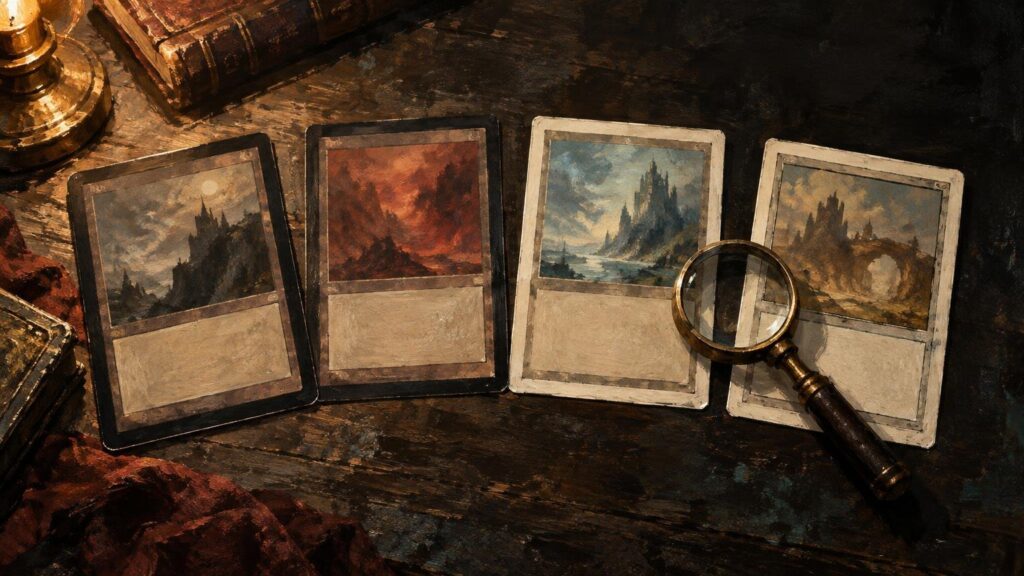
The most useful alpha beta unlimited revised differences are physical. Alpha and Beta have black borders; Alpha has distinctly more rounded corners, while Beta uses the standard corner shape. Unlimited and Revised have white borders, but Unlimited normally has a beveled, double-line inner frame around the art and text area. Revised uses a flatter-looking frame with a single dark inner line, usually lighter-looking art, and smaller rules text. Card pools also matter: Beta expanded and corrected Alpha, Unlimited matched Beta’s card list, and Revised removed 35 entries while adding 39 from Arabian Nights and Antiquities.
Those clues can identify a likely edition, but they cannot authenticate a valuable card. Counterfeits, rebacked cards, alterations, wear, lighting, and ordinary print variation can all complicate identification. Treat this as an edition guide, not a substitute for expert authentication.
Quick identification chart
| Edition | Border | Best visual clue | Card-pool relationship | Printed entries |
|---|---|---|---|---|
| Alpha | Black | Corners are noticeably more rounded than normal Magic cards | First Limited Edition printing | 295 |
| Beta | Black | Standard Magic corner shape | Adds cards, basic-land illustrations, and corrections to Alpha | 302 |
| Unlimited | White | Beveled-looking or double-line inner frame | Matches Beta’s card list | 302 |
| Revised | White | Flatter frame with a single dark inner line; generally lighter appearance | Removes 35 earlier entries and adds 39 from Arabian Nights and Antiquities | 306 |
The counts here are printed card entries, not necessarily the number of mechanically distinct game pieces. Different basic-land illustrations are counted separately. A 1994 rules reference lists Alpha at 295 entries and Beta at 302, and describes Unlimited as using Beta’s card list. It lists Revised at 306 after its card-pool changes.
All four sets use Magic’s original frame era. For a wider look at how this design later evolved, see the history of MTG card frames.
A fast visual decision tree
- Start with the outer border. A black-bordered card is a potential Alpha or Beta printing; a white-bordered card is more likely to be Unlimited or Revised.
- For a black-bordered card, inspect the corners. Alpha’s corners are substantially rounder. Beta adopted the corner shape familiar from later Magic cards.
- For a white-bordered card, inspect the inner boundary around the card’s colored frame. Unlimited has a beveled or double-line appearance. Revised generally has one dark inner line and a flatter look.
- Compare the image and rules-text area. Revised cards commonly look lighter or more washed out and use smaller text, but color alone is not conclusive.
- Check whether the card actually appeared in the suspected set. A perfect-looking frame cannot make a card part of a card pool in which it was never printed.
The Unlimited-versus-Revised frame clue is especially useful because both editions are white-bordered and visually similar at a glance. PSA’s collector guide to Revised describes Unlimited’s double-line, beveled-looking frame and Revised’s single black inner line, along with Revised’s generally lighter art and smaller text.
Color should remain a supporting clue rather than the whole test. Scanner settings, photography, fading, surface wear, and variation between print sheets can change how dark or saturated a card appears.
Alpha versus Beta
Alpha and Beta are the two printings of Limited Edition. Their shared black borders and early card frame make them look closely related, but the corner cut provides the quickest distinction. Alpha cards have an unusually large corner radius. Beta cards have the standard corner profile used by later Magic printings.
The card pools are not identical. The contemporary 1994 reference describes Alpha as 295 printed entries and Beta as 302. It says Beta added two cards, introduced additional basic-land illustrations, and corrected errors found in Alpha. The seven-entry increase therefore does not mean Beta introduced seven mechanically distinct spells.
Volcanic Island is the best-documented example of an Alpha omission. Wizards has explained that it was accidentally left off Alpha’s rare sheet and then appeared in Beta. That means a purported Alpha Volcanic Island is not an obscure variant—it conflicts with the documented set composition.
This also creates a useful distinction within the original dual-land cycle. Nine of the ten appeared in Alpha, while Beta completed the cycle by including Volcanic Island. Wizards identifies the dual lands as originating in Alpha except for that omission.
Beta versus Unlimited
Unlimited is much easier to separate from Beta physically: Beta is black-bordered, while Unlimited is white-bordered. The important historical point is that Unlimited did not introduce another substantially revised card pool. The 1994 reference describes it as matching Beta’s card list.
“Same card list” does not mean “same collectible printing.” Border color, printing characteristics, and edition identity still differ. It only means that a card’s presence in Beta generally cannot, by itself, distinguish Beta from Unlimited. The physical frame must do that work.
Be careful with the word “Limited” in this context. Limited Edition is the set name encompassing Alpha and Beta; it is not the same concept as the Limited gameplay category used for Draft and Sealed. Readers sorting out the gameplay terminology can compare Constructed and Limited deckbuilding.
Unlimited versus Revised
Unlimited and Revised cause the most confusion because both are early, white-bordered base sets. The strongest first-pass difference is the inner frame: Unlimited has a double-line or beveled-looking boundary, while Revised has a flatter single-line treatment. Revised cards also tend to have lighter-looking images and smaller text.
The card list provides a second check. Revised removed 35 entries found in the earlier base-set lineage and added 39 entries from the first two expansions: 20 from Arabian Nights and 19 from Antiquities. That produced 306 printed entries under the same counting convention used above.
This change means a white border does not automatically identify a card as Revised. If the card exists in both Unlimited and Revised, inspect the frame. If it appears in only one of those card pools, a reliable edition checklist can settle the question. Combining card-pool evidence with physical cues is safer than relying on either alone.
What happened to the famous early cards?
Revised did not simply reproduce Unlimited. Many prominent early cards were among its removals, including the Power Nine, so there are no normal Revised printings of those nine cards. Revised did, however, retain the original dual lands. Volcanic Island is therefore absent from Alpha but present in Beta, Unlimited, and Revised.
For players who want to test historically important cards without treating an unofficial copy as authentic, transparent printed MTG playtest cards can provide a clearly differentiated stand-in. Keep the categories separate: an authentic card is official Magic product, a playtest card is an acknowledged substitute, and a counterfeit is presented or intended to be presented as authentic. More context is available in the comparison of proxy cards and real cards.
Release order and historical dates
The sequence is Alpha, Beta, Unlimited, then Revised. MTGDatabase catalogs commonly cited release dates of August 5, 1993 for Alpha; October 4, 1993 for Beta; December 1, 1993 for Unlimited; and April 11, 1994 for Revised. These dates are useful catalog references, but they should be attributed rather than treated as an independently verified archival chronology without contemporary Wizards or distributor documentation.
The more durable historical relationship is the progression of the card pools: Alpha began Limited Edition, Beta added omitted material and corrections, Unlimited reprinted Beta’s list with white borders, and Revised substantially revised that list with removals and cards drawn from Arabian Nights and Antiquities.
Printed wording versus current Oracle text
An early printing’s wording is historically interesting, but it is not necessarily the wording used to resolve a current game. Magic’s Comprehensive Rules define Oracle as the official card reference text and identify Gatherer as the official card database.
That distinction matters because early cards may use obsolete templates, older terminology, or wording that no longer communicates the complete rules operation. When playing one today, look up its current Oracle text rather than trying to interpret every sentence exactly as printed. The anatomy of those fields is covered in the guide to reading a Magic card.
Edition and legality are separate questions as well. Identifying a card as Beta, Unlimited, or Revised does not by itself establish whether the card is legal in a particular format. Legality follows the card and the format’s current rules, restrictions, and banned list.
What these visual cues cannot prove
A border, corner shape, or frame treatment can support edition identification, but it cannot prove authenticity. Exercise particular caution when examining expensive cards or cards offered without reliable provenance.
- A white border does not automatically mean Revised; Unlimited is also white-bordered.
- A black border does not automatically mean Alpha or Beta; later printings and other editions may also have black borders.
- Wear or trimming can distort a card’s apparent corner shape.
- Lighting, fading, scanners, and print variation can change perceived color and contrast.
- Rebacking, alteration, and counterfeit production can imitate individual visual features.
- Collector’s Edition, International Edition, Summer Magic, foreign-language editions, and Fourth Edition require their own identification checks.
For an ordinary collection sort, border color, corners, inner-frame treatment, and card-pool membership form a practical four-part check. For a high-value transaction, use detailed front-and-back inspection and qualified authentication rather than a web image comparison alone.
The distinction that resolves most identifications
Start with border color, then narrow the result with one physical feature. Black border plus strongly rounded corners points toward Alpha; black border plus standard corners points toward Beta. White border plus a beveled double-line inner frame points toward Unlimited; white border plus a flatter single-line frame points toward Revised.
Finally, verify that the named card belongs to that set. That last step catches mistakes visual inspection cannot—especially Alpha’s missing Volcanic Island and Revised’s changed card pool. Appearance identifies the likely printing; a documented checklist confirms whether that identification is possible.