
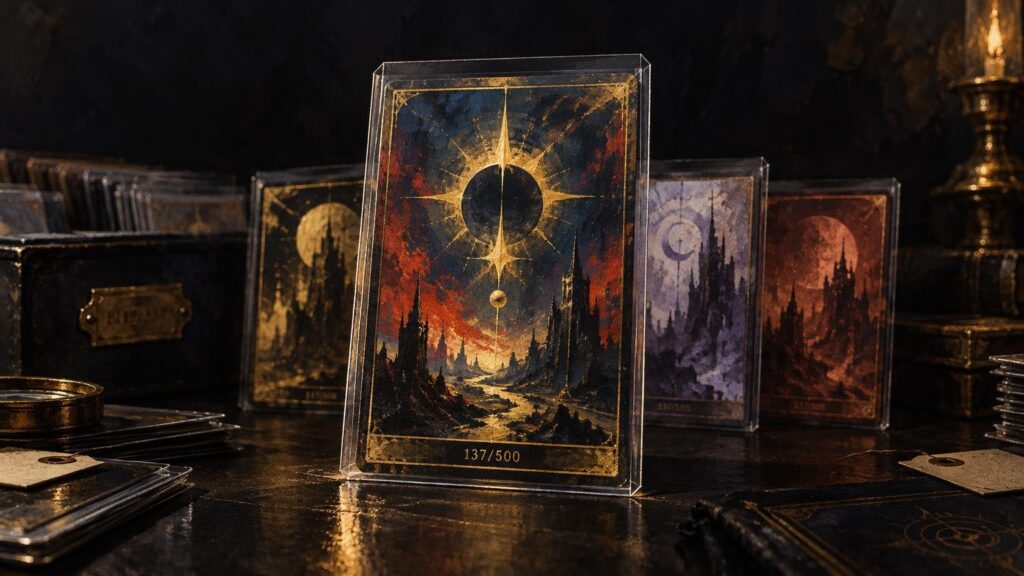
TLDR: A serialized MTG card is an official card from a limited, individually numbered issue. A number such as 137/500 means that copy is numbered 137 within an announced run of 500 copies of that particular serialized version. It does not change the card’s rules, power, or legality. The serial number is also different from the card’s collector number, which identifies its position within a set or product.
Magic’s serialized cards can look complicated because serialization overlaps with foils, showcase frames, alternate art, special languages, and other collectible treatments. The key is to treat serialization as one attribute of a particular printing—not as a separate game mechanic or a universal visual style.
What is a serialized MTG card?
Wizards of the Coast introduced serialized cards in a Magic booster product with The Brothers’ War in 2022. Its serialized schematic artifacts displayed both an individual number and the total size of the issue. Each of the 63 eligible artifacts had 500 serialized copies, producing 31,500 cards across that program—but only 500 copies of each individual card. Wizards’ collecting guide for The Brothers’ War explains the original release structure.
A serialized card is mechanically identical to the corresponding non-serialized version. If two copies have the same Oracle characteristics, adding a stamped number to one does not give it a new ability or make its spells stronger. Serialization matters to collectors, not to the rules engine.
How to read a number such as 137/500
The notation has two parts:
- 137 is the individual number assigned to that copy.
- 500 is the total number of copies in that specific serialized issue.
The denominator is the useful number when comparing scarcity across official programs. A card numbered 137/500 belongs to a larger issue than one numbered 137/250. The numerator distinguishes one copy from another within the run.
The numerator does not reveal when the card was opened, and it does not affect gameplay. Certain numbers may attract more collector attention for thematic or personal reasons, but that is preference rather than a rules distinction. A low numerator should not be confused with an earlier set printing or a different edition.
Serial number versus collector number
A collector number is part of ordinary Magic card identification. It indicates where that card or variant falls within the numbered contents of its set or product. A serial number identifies one physical copy within a deliberately limited issue.
| Identifier | Example | What it identifies |
|---|---|---|
| Collector number | 123/281 | The card or variant’s place in a set or product checklist |
| Serial number | 137/500 | One numbered copy within a limited serialized issue |
A serialized card can display both identifiers. When cataloging it, record both rather than treating one as a substitute for the other. For more help locating the set symbol, collector number, and other printed identifiers, see how to read every part of a Magic card and our guide to MTG set symbols and printing identification.
Serialization is not a single treatment
Magic uses “treatment” for a card’s special visual presentation. That can involve a different frame, artwork, finish, or combination of features. A treatment may exist only as a serialized issue, only as a non-serialized card, or in both forms. “Serialized,” therefore, does not tell you exactly what a card looks like.
Double rainbow foil is one named finish associated with several serialized releases, but the terms are not interchangeable. Likewise, a showcase card is not automatically serialized. Murders at Karlov Manor included serialized Ravnica City cards and separate showcase dossier cards with invisible-ink features. Those were distinct collectible programs within the same release. If alternate frames are the confusing part, our guide to showcase MTG cards explains how those variants work.
“Headliner” is another adjacent term rather than a synonym. Wizards introduced Headliner cards with Innistrad Remastered in January 2025 to identify a featured card in a release’s Booster Fun lineup. A Headliner can have a serialized version, but being the Headliner does not itself define the print quantity or numbering.
Serialized runs can have very different sizes
There is no universal “serialized print run” for Magic. Wizards has used issues of 250, 500, 700, 900, and even a single copy. The Lord of the Rings: Tales of Middle-earth contained the traditional-foil One Ring numbered 001/001. Its serialized Elven, Dwarven, and Human Sol Rings had respective runs of 300, 700, and 900. Wizards’ Lord of the Rings collecting overview documents those separate issues.
Other releases illustrate the range. Ravnica Remastered used 500-copy runs for 64 serialized retro-frame rares and mythic rares, while Murders at Karlov Manor used 250-copy runs for its serialized Ravnica City cards. The number on a card must therefore be interpreted alongside its exact release and variant.
Language, art, and booster placement can also vary
English-only serialized issues have been common, but they are not a rule. The Brothers’ War serialized schematic artifacts were English-only, while Assassin’s Creed serialized historical figures appeared in character-appropriate languages, including Italian and Greek.
Artwork may also distinguish the serialized issue. March of the Machine gave its serialized Praetors unique art, rather than merely placing numbers on every ordinary version. Many serialized programs have appeared in Collector Boosters, but distribution is release-specific. Check the official collecting article for the exact set before assuming which booster can contain a card or what quantity was issued.
Does a serialized number change legality?
No. Format legality follows the underlying card and the applicable format rules, not the stamped numerator or denominator. If a card is legal in a format, its serialized printing can normally represent that same card. If the underlying card is not legal, serialization does not create an exception. Release context can still matter because cards associated with one product may enter different format card pools.
How to identify a serialized printing accurately
The card name alone is not enough. Record the following details when cataloging, comparing, insuring, grading, or discussing a serialized card:
- Card name
- Set or associated release
- Collector number
- Frame, artwork, or named treatment
- Foil or other finish
- Complete serial notation, including the denominator
- Language
- Condition
Then compare those details with the official card gallery or collecting guide for the release. Be cautious when using promotional images as physical references: some official premium-card images are labeled as digital renders, so an image alone does not verify the characteristics or authenticity of a physical copy.
How to store serialized Magic cards
A serialized card is still a paper-based collectible, so its number does not require a mysterious special storage technology. The practical priorities are reducing unnecessary handling, avoiding prolonged light exposure, and maintaining a stable environment.
Use an appropriately sized, inert, PVC-free sleeve and consider a rigid outer holder for additional protection against bending and handling. The Library of Congress preservation guidance identifies polyethylene, polypropylene, and polyester/PET without added slip or coating agents as stable enclosure materials and advises avoiding PVC and unknown plastics. A rigid holder is a practical protective layer, not a Magic-specific archival certification or grading standard.
Keep valuable cards away from attics, basements, garages, direct sunlight, leaks, and large temperature or humidity swings. Plastic containers can add some water protection, but they cannot make an unstable environment safe; trapped humidity can introduce its own risks. The National Archives preservation guidance also reinforces the broader principle that display, repeated handling, pressure, light, and long-term storage create different preservation concerns.
The number identifies the copy, not a different card
The simplest way to understand serialized MTG cards is to separate game identity from collectible identity. The underlying card determines what it does and where it is legal. Its set, frame, art, finish, language, and collector number identify the printing. The visible fraction then identifies one copy within that printing’s limited serialized issue.
That distinction resolves most of the terminology: 137/500 means copy 137 in a 500-copy issue. It does not mean card 137 in the set, a stronger version in play, or a universally comparable rank across every serialized Magic release.
References
- What's Inside The Brothers' War Boosters?
- A First Look at The Brothers' War | Magic: The Gathering
- Anatomy of a Magic Card | MAGIC: THE GATHERING
- Collecting Murders at Karlov Manor
- The Foundations of Magic's Next Era
- Collecting The Lord of the Rings: Tales of Middle-earth™
- Collecting Ravnica Remastered
- Collecting March of the Machine
- Collecting Lorwyn Eclipsed: The Four Most Important Things to Know
- General Preservation – FAQ – About (Preservation, Library of Congress)
- Photographs | National Archives