
TLDR: Cube Draft in one minute
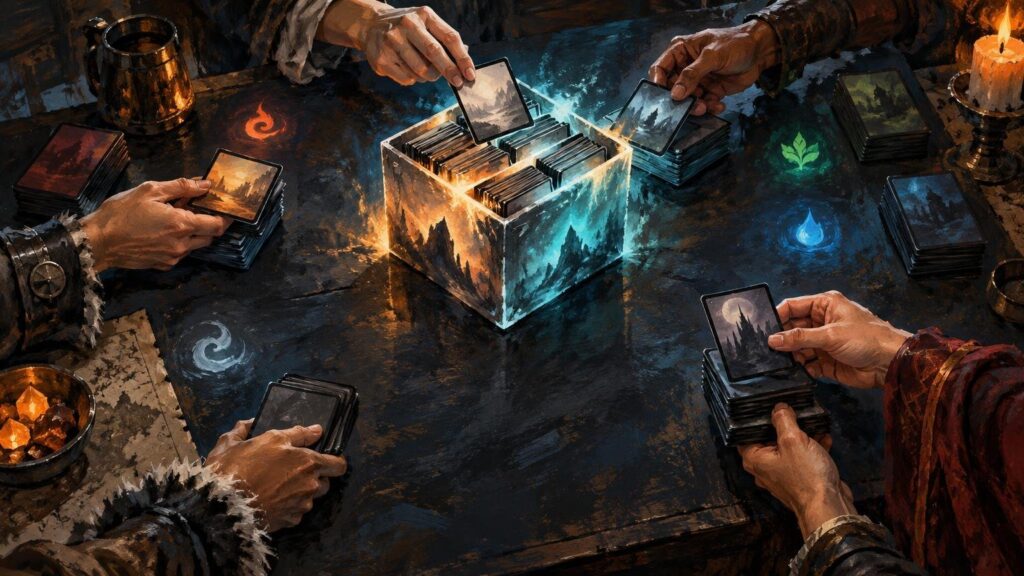
An MTG Cube is a curated collection of Magic cards assembled specifically for drafting and other Limited play. Instead of opening retail booster packs, the organizer randomizes cards from the Cube into draft packs. Players pick and pass those cards, build Limited decks, play their matches, and usually return the cards afterward.
The important part of MTG Cube Draft explained simply is that Cube is not one fixed format with one universal card pool. The Cube's curator chooses its cards, themes, power level, duplicate policy, and house rules. Three 15-card packs and 40-card decks are familiar defaults, but the organizer can change them. Ask about the Cube list, deckbuilding rules, basic lands, card ownership, and any special procedures before drafting.
What makes a Cube different from a normal Booster Draft?
A conventional Booster Draft uses sealed booster packs associated with a published Magic release or draft environment. A Cube Draft uses packs assembled from a collection selected by an individual, store, playgroup, or digital event designer. Wizards describes Cube as a customizable collection for drafting and Limited play rather than a product that must be opened for each event. Wizards' introduction to building a Cube also emphasizes that its contents and structure can be adapted to the creator's goals.
| Question | Booster Draft | Cube Draft |
|---|---|---|
| Where do the cards come from? | Unopened boosters for a published draft environment | Randomized packs made from a curated collection |
| What defines the card pool? | The relevant set or product | The Cube curator's chosen list |
| Are the cards reusable? | Not normally as the same draft product | Yes; a paper Cube can be collected and randomized again |
| Do players keep the cards? | Depends on the event, but keeping drafted cards is common | Usually determined by the Cube owner or event rules |
| Is there one universal environment? | Each product has a defined card pool | No; every Cube may present a different environment |
That freedom lets a Cube combine cards from across Magic's history, concentrate on one plane or mechanic, imitate a particular era, or enforce an unusual restriction. A curator might build around artifacts, multicolor decks, common and uncommon cards, old-border cards, or a deliberately high-powered selection. Those are possible Cube designs, not rules every Cube must follow.
Cube is still a form of Limited play because players build their decks from cards acquired during the draft rather than bringing completed decks from home. That distinction is explored further in the differences between Constructed and Limited deckbuilding.
How a typical MTG Cube Draft works
The most recognizable Cube procedure closely follows Booster Draft. A common eight-player model uses a 360-card Cube, giving each player three packs of 15 cards. Singleton construction—only one copy of each card in the Cube—is also common. Neither eight players, 360 cards nor singleton construction is mandatory. Larger Cubes, duplicate cards, smaller pods and alternative pack sizes can all work when the curator designs for them.
1. The organizer creates randomized packs
The organizer shuffles or otherwise randomizes the Cube and divides part or all of it into packs. These are functional draft packs, not sealed retail boosters. The organizer should explain whether the entire Cube is being used, whether cards have been seeded into packs, and whether any special collation rules apply.
2. Players pick and pass
Each player opens a pack, chooses one card, and passes the remaining cards to the next player. Everyone repeats the process until all cards from that pack have been selected. With the familiar three-pack structure, the passing direction changes for the second pack and changes back for the third. This follows the standard pick-and-pass procedure used for formal Booster Draft.
All picks become part of that player's draft pool. You are not required to put every selected card into the main deck; some picks will remain available as sideboard options under the event's deckbuilding rules.
3. Players build Limited decks
Sanctioned Limited rules use a minimum deck size of 40 cards. Cards drafted but not placed in the main deck can form the player's sideboard, and basic lands may be added under the applicable Limited procedures. A casual Cube can adopt that structure because it is familiar and easy to run, but the host should say so rather than assuming every group uses identical rules.
A practical first build usually starts with a functional mana base and enough spells that affect the game. The exact land count depends on the deck's curve, colors, fixing and special mechanics; Cube does not create a universal number that fits every deck.
4. The group plays matches and handles the cards as agreed
Match structure is up to the event. A local group might run three rounds, play a single-elimination bracket, or simply pair people for casual games. Card ownership also needs to be explicit. In many paper Cubes, all cards remain the Cube owner's property and are returned after play.
An event described as phantom does not award the drafted cards to players. Wizards' dated Arena Powered Cube is one official example of a phantom Cube event with its own 540-card singleton pool and curated archetypes. Its list and procedures describe that particular event, not Cube as a whole.
Common Cube terms worth knowing
- Cube: The complete curated card collection used to create the draft environment.
- Curator or Cube owner: The person or group selecting, maintaining and updating the card pool.
- Cube list: A record of the cards included. Looking at it before the event can reveal supported themes, mana fixing and unusual rules.
- Singleton: A Cube containing only one copy of each included card. This is a convention, not a requirement.
- Powered Cube: Usually a high-powered environment that includes exceptionally strong cards, potentially including Magic's famous Power Nine. Ask what the label means for that specific list.
- Archetype: A supported deck theme or strategy, such as reanimator, artifacts, aggressive creatures or multicolor control.
- Mana fixing: Lands and spells that help a deck produce the colors it needs. Its availability affects how safely players can draft multiple colors.
- Phantom draft: A draft in which participants do not keep the cards they select. Prize arrangements are a separate question.
What can change from one Cube to another?
Almost every structural choice can change. That flexibility is the attraction, but it is also why arriving with assumptions from another Cube can cause confusion.
- Card pool and power level: A Cube might range from beginner-friendly cards to unusually efficient and complex ones.
- Size and player count: The familiar 360-card, eight-player setup is only one model.
- Duplicates: Singleton is common, but a designer can include multiple copies to make themes more reliable.
- Pack structure: Packs do not have to contain 15 cards, and players do not always draft exactly three.
- Deckbuilding: Forty-card decks are a recognizable Limited default, but house variants can use another minimum.
- Basic lands: The organizer may supply them physically, use a shared land station, or handle them automatically on a digital platform.
- Play mode: Some Cubes are designed for ordinary one-on-one matches, while others target multiplayer or another variant.
- Ownership and prizes: Keeping cards, returning cards and receiving prizes are distinct issues that should be stated in advance.
- Custom rules: A Cube can introduce custom cards, special draft mechanics, seeded packs or other procedures if participants know what to expect.
How to approach your first Cube Draft
You do not need to memorize an entire Cube list before playing. You do need to understand what kind of environment you are entering. If the list is available, scan its themes, lands, multicolor cards and build-around effects. If it is not available, ask the curator for a short description.
During the draft, look for a coherent deck rather than collecting isolated powerful cards. Early selections can remain flexible, but later picks should increasingly support a workable plan. Pay attention to mana requirements: three exciting cards in three different colors are less useful if the Cube does not provide enough fixing to cast them reliably.
Interaction also matters. Creature removal, counterspells, discard, artifact answers and combat tricks do different jobs, and their value depends on the environment. There is no universal best color or pick order across all Cubes because the curator controls which cards and archetypes exist.
Reading the cards remains more important than recognizing every reference or historical staple. If an unfamiliar card has several abilities, work through its mana cost, type line and current rules text methodically. The beginner guide to reading every part of a Magic card can help if Cube exposes you to older frames or unusually dense designs.
Banned cards, legality and proxies in Cube
Constructed banned and restricted lists do not function as a universal Cube ban list. Wizards publishes restrictions by format, while Limited card availability ordinarily comes from the product or pool being drafted. In Cube, the curator determines the available card pool and can exclude any card for power, complexity, cost, theme or play-pattern reasons. Wizards' current Banned & Restricted page is useful for checking Constructed formats, but it does not define every home Cube.
The same event-specific principle applies to proxies and playtest cards. A private Cube owner may permit clearly identified stand-ins, particularly for testing changes or avoiding repeated handling of valuable cards. Another host may require authentic cards, while a sanctioned event can have separate policy requirements. Ask rather than assuming permission.
Transparent playtest cards should not be represented as authentic Magic cards. For background on that distinction, see why players use proxies for Cube and playtesting. If a Cube owner chooses physical stand-ins of existing MTG printings, printing cards for a Cube is one possible production route, but acceptance still depends on the host and event.
Questions to ask before the event
- Can I see the Cube list or a summary of its supported themes?
- How many players are expected, and how many packs and cards will each player draft?
- Is the Cube singleton, powered, themed, rarity-restricted or designed for multiplayer?
- Are basic lands supplied?
- What is the minimum deck size, and how will sideboards work?
- Is the draft phantom, or does anyone keep drafted cards?
- Are proxies, playtest cards or custom cards included or permitted?
- What match structure, time limit and prize arrangement will be used?
The key idea to remember
Cube Draft uses the familiar machinery of Limited—select cards from packs, pass the rest, and build a deck—but replaces unopened boosters with a reusable, curator-defined card pool. That single change gives the designer enormous control over the environment.
For a first Cube, do not worry about learning a supposedly universal metagame. Find out which Cube you are drafting, confirm its house rules, and build the most coherent deck your picks and mana can support. The draft procedure may feel familiar; the contents are where every Cube develops its own identity.