
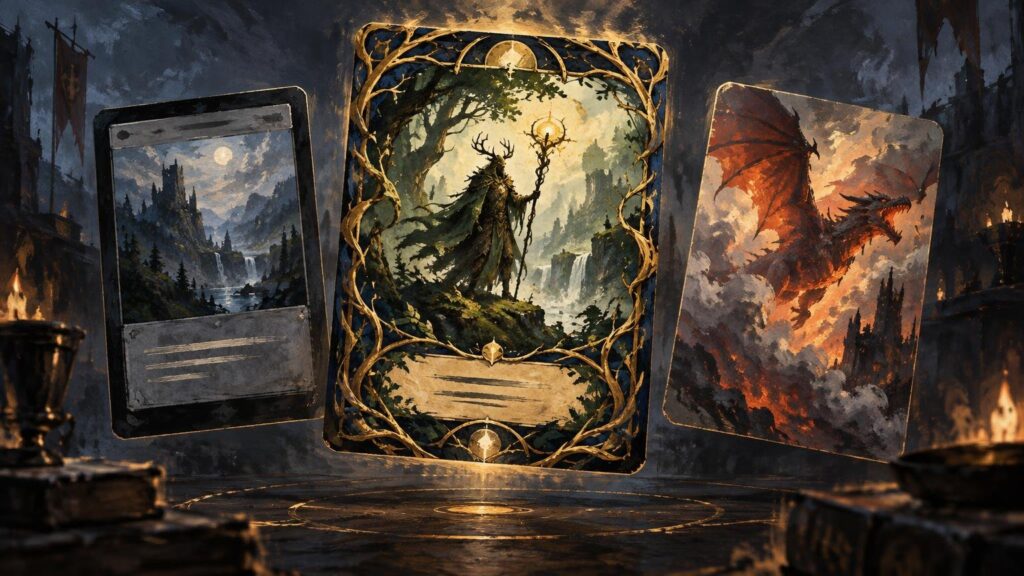
TLDR: A showcase MTG card is an official printing with an alternate visual presentation, usually built around a set-specific frame and art direction. “Showcase” describes the card’s appearance, not a mechanic, card type, rarity, or format. A showcase printing normally has the same Oracle text and gameplay function as the regular version of that card.
The potentially confusing part is that showcase cards do not share one universal look. One set might use storybook frames, another might emphasize a plane’s architecture, and another might give selected cards a dramatically different illustration style. Wizards of the Coast uses “showcase frames” as a broad category for these set-themed treatments rather than the name of a single frame template.
What “showcase” means on an MTG card
Showcase is one branch of what Wizards calls Booster Fun: alternate versions intended to give cards visually distinctive treatments within a release. The modern initiative began with Throne of Eldraine in October 2019, whose Adventure cards received storybook-inspired showcase frames. Wizards later described that treatment as the first official Booster Fun treatment. Wizards’ original Project Booster Fun explanation
That first example also shows why “showcase” is more of a design category than a precise visual specification. Throne of Eldraine’s treatment looked like an illustrated storybook, while Zendikar Rising used a different showcase treatment for selected landfall cards. Each presentation reflected its own set rather than following a permanent showcase layout.
If you are learning the basic parts of a card, start with how to read a Magic card. The showcase treatment can rearrange or decorate those parts, but the card still needs to communicate essentials such as its name, mana cost, type line, rules text, and combat statistics where applicable.
Does a showcase card work differently?
No. There is no separate Oracle text attached to “showcase” as a designation. Oracle text belongs to the named card, so choosing a showcase printing does not add an ability, improve its statistics, or change how that card resolves.
Suppose a card has a normal-frame printing and a showcase printing. If both represent the same named card, they use the same current Oracle wording even if their printed layout, illustration, or decorative frame differs. This distinction between printed presentation and current rules information matters whenever older wording, unusual layouts, or alternate treatments are involved.
Showcase status also says nothing by itself about how powerful the card is. It is packaging and presentation, not a gameplay upgrade. A visually extravagant version of a modest Limited card remains that same modest Limited card.
Showcase versus borderless, extended-art, and foil cards
Magic has enough alternate treatments that players sometimes use “showcase” as shorthand for anything unusual. Official product descriptions are more specific. Showcase, borderless, extended-art, retro-frame, serialized, and full-art cards can be separate categories.
| Treatment | What it describes | What it does not establish |
|---|---|---|
| Showcase | A release-specific alternate frame and art presentation | Rarity, legality, or different rules |
| Borderless | Artwork presented without the normal card-frame boundaries | That the card is necessarily a showcase version |
| Extended art | Artwork extended into the left and right portions of the frame | A distinct game object or new card |
| Foil | A reflective finish applied to a card | A particular frame category |
| Retro frame | A treatment recalling an older Magic frame | The card’s actual age or original set |
These properties can overlap. Depending on the release, a showcase version may also be foil, while the same card may have separate borderless or extended-art variants. Wizards’ Assassin’s Creed product reveal, for example, listed showcase cards alongside other Booster Fun treatments rather than treating every alternate version as interchangeable. the official Assassin’s Creed card treatment overview
For a wider view of how the game’s visual structure has evolved, see the history of MTG card frames. That history explains why an alternate frame can look radical while still remaining recognizably Magic.
Are showcase cards rarer?
Not automatically. Showcase is a treatment, while rarity is the common, uncommon, rare, or mythic rare classification associated with a printing. Throne of Eldraine included showcase cards across all four of those rarities, so the presence of a showcase frame alone cannot tell you that a card is rare.
Availability is equally release-specific. One product may place a showcase card in a dedicated slot, while another may mix showcase versions into a broader range of treatments. Throne of Eldraine Collector Boosters used dedicated special-frame slots, whereas Assassin’s Creed Beyond Boosters included a slot for a showcase uncommon, rare, or mythic rare.
That means you should consult information for the exact set and booster product rather than relying on a general rule about showcase pull rates. Product configurations change, and even two products tied to the same release can distribute treatments differently.
Are showcase cards tournament legal?
A showcase frame does not determine format legality. Legality depends on the underlying card, the format’s card-pool rules, and any current banned or restricted list. A showcase version cannot make an otherwise illegal card legal, and it does not make a legal card illegal merely because the frame looks unusual.
For sanctioned play, the important distinction is between an authorized Magic card and an unofficial stand-in. The Magic Tournament Rules permit genuine, publicly released Wizards printings when the underlying card is legal for the event, subject to the rules governing card condition, identification, and use. Non-authorized cards are prohibited. the current Magic Tournament Rules
Format rules can still change over time. Before entering an event, check the current legality of the named card rather than assuming that an older or especially collectible treatment guarantees eligibility. For an example of how format card pools and bans work, see this explanation of the Modern format.
How to identify a particular showcase printing
The card name is only the beginning when cataloging or buying a specific variant. Record enough information to distinguish the showcase printing from the regular, borderless, foil, or other versions of the same card.
- Exact card name
- Set name and set code
- Collector number
- Showcase or other treatment description
- Foil or nonfoil finish
- Language, when relevant
Set code and collector number are especially useful because artwork alone can be misleading in a game with reprints and multiple treatments. Magic: The Gathering—Assassin’s Creed, for example, uses the set code ACR and distinguishes showcase versions from other alternate presentations in the release.
For collecting purposes, verify the exact variant before comparing listings or prices. A card being showcase does not prove it is scarce, expensive, foil, or mechanically special. It tells you that the printing belongs to a set-defined family of alternate visual treatments.
The distinction that resolves the confusion
A showcase card is best understood as the same Magic card wearing a release-specific visual design. Its alternate frame and artwork may make it more appealing to a collector or better suited to a deck’s visual theme, but the showcase label does not create new rules, rarity, strength, or legality. Identify the printing by its set details and treatment; understand gameplay through the card’s current Oracle text.
References
- Project Booster Fun | MAGIC: THE GATHERING
- 30 Years, Part 3
- Collecting Zendikar Rising | MAGIC: THE GATHERING
- media.wizards.com
- media.wizards.com
- MTG Product Guide | Magic: The Gathering
- A First Look at Magic: The Gathering® – Assassin's Creed®
- MAGIC: THE GATHERING® TOURNAMENT RULES
- MTG Standard Format | Magic: The Gathering