
TLDR
Magic: The Gathering | Star Trek is reportedly aiming for a slightly slower rhythm that builds toward larger late-game plays. Spacecraft will be the clearest test of whether that approach works. Because station asks players to commit creatures, time, and sorcery-speed actions, the best Spacecraft need to provide useful value before their final threshold—or deliver a final payoff strong enough to justify the wait. The design intent sounds promising, but upcoming card previews must show that the journey is worth taking.
The most important detail in the early Magic Star Trek Spacecraft design discussion is not simply that games may run longer. It is that those extra turns are supposed to lead somewhere. In an October 3, 2026 interview, Magic principal designer Gavin Verhey described the set as having a slightly slower rhythm that builds toward larger late-game moments. He also discussed stronger support for Spacecraft, the land-focused Strange New Worlds mechanic, and choice-driven Face a Dilemma cards. Read the full Gavin Verhey interview
That creates a useful standard for evaluating the set before anyone knows how its Limited environment or Constructed cards will perform. Slowness is not inherently a virtue. Players must receive something interesting in exchange for spending additional turns developing mana, filling a board, and advancing permanents. Spacecraft are where that exchange will be easiest to see.
Spacecraft are the stress test for Star Trek’s slower games
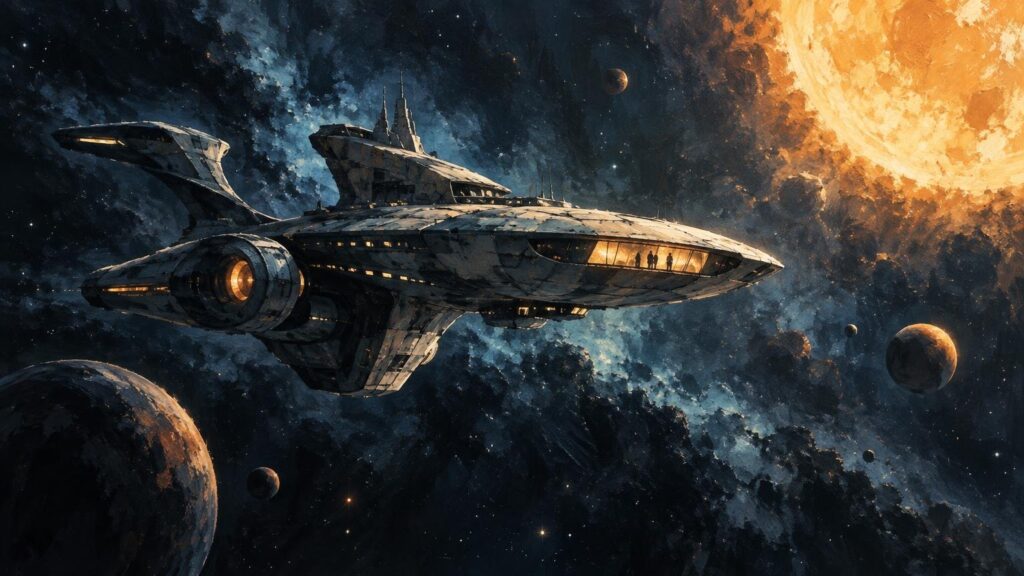
Wizards has confirmed that Spacecraft and station, introduced in Edge of Eternities, are a major part of Magic: The Gathering | Star Trek. The mechanic naturally fits the source material: ships need crews, and a starship becoming fully operational can feel like a story unfolding on the battlefield. Mechanically, however, station is a demanding way to tell that story.
A player stations a Spacecraft at sorcery speed by tapping another untapped creature. The Spacecraft then receives charge counters equal to that creature’s power. Printed thresholds can unlock abilities, and a Spacecraft with an appropriate final threshold can eventually become a creature.
The word “tapping” can make the cost sound smaller than it is. The creature is not sacrificed, and station does not require spending mana unless an individual card says otherwise. But an untapped creature is still a resource. Using it to station may prevent it from blocking, activating another tap ability, or contributing elsewhere that turn. A creature can sometimes attack first and station during the second main phase, but only if it remains untapped and survives combat. The sorcery-speed restriction also means the opponent can see the investment coming.
Station therefore rewards a developed board while creating tension over how that board should be used. A small utility creature might add counters slowly. A large creature can supply more counters, but tapping a major threat may represent a more significant opportunity cost. If several activations are required, the player is making a multi-turn investment that interaction can disrupt.
That is why “Spacecraft are stronger this time” cannot be judged by the final creature statistics alone. A spectacular last line of rules text means little if the card spends too many turns doing too little.
How to judge the Magic Star Trek Spacecraft design
As previews arrive, four questions will reveal more than splashy power and toughness numbers.
Does the Spacecraft do anything immediately?
A Spacecraft that generates a card, affects the battlefield, or offers a useful activated ability before being stationed is easier to justify than one that arrives as a dormant project. Immediate value does not need to be dramatic. Its job is to prevent the player from falling hopelessly behind while preparing the larger payoff.
Wizards has already identified this concern in its account of Edge of Eternities design. Mark Rosewater explained that some station cards received enters-the-battlefield or activated abilities so they could justify their mana values and fit more readily into decks. That lesson should matter even more in a set advertised as building toward major late-game moments.
Are the intermediate thresholds meaningful?
The healthiest version of station is a progression rather than an on-off switch. An early threshold might improve defense, provide selection, or create another modest advantage. The final threshold can then supply the cinematic moment without making every previous turn feel empty.
Intermediate rewards also create better decisions. A player may station just enough to unlock a useful ability, then redirect creatures toward combat. If only the last threshold matters, the mechanic risks becoming an arithmetic exercise in reaching one enormous number as quickly as possible.
Can ordinary creatures meet the thresholds?
Thresholds should be evaluated against the creatures the set actually provides, not an imaginary battlefield full of oversized threats. A requirement that looks reasonable beside a five-power creature may be cumbersome if the surrounding environment mostly supplies creatures with one or two power.
Support cards matter here. Effects that place charge counters, untap creatures, reward station activations, or provide creatures that have already delivered their main value could reduce the mechanic’s opportunity cost. Until those cards and their frequencies are visible, claims about Spacecraft being easier or stronger remain design aspirations rather than demonstrated outcomes.
Does the final payoff change a stabilized game?
A slower format often produces crowded boards. If a Spacecraft requires several turns of preparation, merely becoming another large creature may not be enough. Evasion, protection, card advantage, or a battlefield-changing triggered ability can matter more than raw size when both players already have defenses.
This does not mean every ship needs to end the game immediately. It does mean the payoff should address the kind of game the set is promising. If players are encouraged to reach later turns, expensive projects must remain relevant once they get there.
Slower play can make setup cards better—or expose their weaknesses
A slower environment gives Spacecraft more time to accumulate counters, but that alone does not make them good. The same environment may also give opponents time to hold removal, develop blockers, or answer the creatures needed to station a ship. One efficient response can be especially punishing when it undoes several turns of visible investment.
This is the strongest counterpoint to the set’s appealing design pitch. Large late-game moments are satisfying when both players have been making consequential decisions on the way there. They are less satisfying when one player spends multiple turns charging a permanent only for the game to hinge on whether the opponent has a single removal spell.
The card file can reduce that risk in several ways: useful abilities before the final threshold, value when a Spacecraft enters or leaves the battlefield, protection that carries a real cost, or multiple threats that prevent one removal spell from ending the entire plan. The important feature is not immunity to interaction. It is ensuring that interaction produces a fair exchange rather than erasing an excessive investment for very little cost.
Strange New Worlds supports the theme, not yet the conclusion
Verhey also described Strange New Worlds as rewarding players for controlling differently named lands. That idea is compatible with a game in which players continue developing resources and care about the shape of their mana base. It may encourage decks to diversify lands instead of treating every land drop as interchangeable.
It does not, by itself, prove that the set will play slowly. A mechanic can care about differently named lands while appearing on inexpensive cards or rewarding players early. Its practical effect will depend on costs, colors, rarity, payoff size, and the availability of suitable lands. Those details are not established by the broad mechanic description.
Still, Spacecraft and Strange New Worlds appear to point in the same conceptual direction: development should remain relevant across several turns. One mechanic asks players to build operational capacity through creatures and charge counters; the other rewards a varied land base. The promising version of that design makes each stage useful. The weaker version asks players to assemble resources while faster decks simply end the game.
A practical checklist for upcoming previews
When a new ship is revealed, do not stop at its final form. Read the card from mana cost through its complete rules text, then ask how it behaves on every turn before it becomes fully operational.
- What does the Spacecraft provide on the turn it enters?
- Is there a useful intermediate station threshold?
- How many typical creatures or station activations are needed to reach each threshold?
- What attacks, blocks, or activated abilities might the player give up to station it?
- Does the card retain value if the opponent removes it before the final threshold?
- Can the completed Spacecraft break through a developed battlefield?
- Do other cards in the set reduce the cost of stationing or reward the action itself?
Those questions apply differently across formats. Limited needs enough playable creatures and support at relevant rarities. Constructed demands efficiency and resilience because opposing interaction is more focused. Commander offers more time and larger creatures for stationing, but it also introduces multiple opponents who can answer a visible threat. No single preview card can settle all three environments.
The release calendar leaves room for evidence
Wizards has announced prerelease events for November 6–12, 2026, an MTG Arena release on November 10, and a global tabletop release on November 13. Those dates separate the current design discussion from the point when players can evaluate complete decks and repeated games.
Until then, the right verdict is bounded. Magic: The Gathering | Star Trek has an intelligible mechanical promise: give players time to develop, make Spacecraft more rewarding, and let that setup culminate in memorable late-game plays. That is more interesting than slowing games merely to showcase expensive cards.
But the promise succeeds only if the cards respect what station costs. Creatures are not free batteries, turns are not free time, and a giant final form does not automatically repay an empty early game. The previews that matter most will be the ships that remain useful before launch, offer meaningful milestones, and genuinely alter the game once fully stationed. If Star Trek delivers those, its slower rhythm may feel like anticipation. If it does not, it will feel like waiting.