
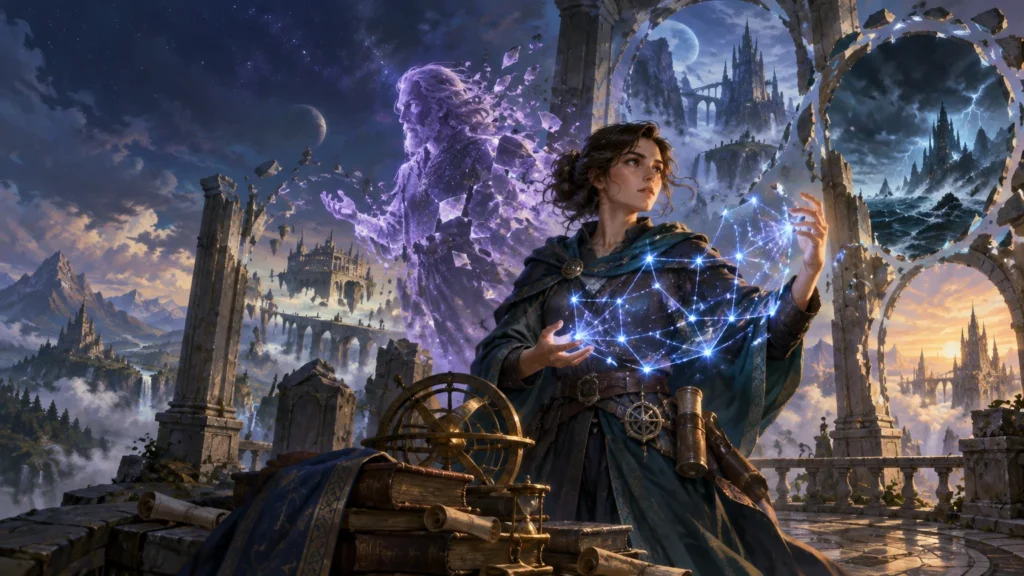
Spoiler warning: Reality Fracture Episode 10 Tam Jace spark details follow. TLDR: The finale kills the physical Jace known as the Theorist, transfers his planeswalker spark to Tam, and reveals that she was created as his fail-safe. The important twist is not simply that Tam inherits Jace’s power. She inherits an unfinished instruction from him after already proving that she can reject his judgment.
That makes Tam, rather than Jace, the character who now controls the future of his work. Episode 10 does not confirm that she will continue the Theorist’s attempt to rewrite existence, nor does it establish that she has become “the new Jace.” It gives her the spark, the message, and—most importantly—the choice.
What Reality Fracture Episode 10 confirms about Tam and Jace’s spark
Wizards of the Coast published Reality Fracture Episode 10: Happy Birthday on September 10, 2026. During the conclusion, the Theorist’s physical body dies and his spark leaves that body before entering Tam. The episode then has Tam receive a message embedded within the spark. Jace identifies her as his fail-safe, says that he created her to inherit the spark, and asks her to continue “our work” and make things better.
On the level of plot mechanics, this is a succession scene. Jace has anticipated his own failure and arranged for another being to receive both his ability to travel the Multiverse and a final directive. His plan therefore survives his body, even if the planner does not.
But “succession” is not the same thing as replacement. Tam does not simply wake up as Jace under another name. The finale confirms the transfer of the spark and the delivery of the contingency message; it does not explain that Tam receives all of Jace’s memories, identity, abilities, or convictions. Treating the transfer as a complete personality overwrite would go beyond what the episode establishes.
The contingency message changes who has narrative agency
Jace’s final request is deliberately broad. “Continue our work” could refer to preserving something from the Echoverse, repairing damage, pursuing a more ethical version of his goals, or carrying forward a plan not yet fully disclosed. Episode 10 does not provide enough detail to reduce that language to one confirmed mission. It especially does not confirm that Tam intends to restart the Theorist’s reality-rewrite project.
That ambiguity is the point on which the finale turns. Jace can pass on power and issue an instruction, but he cannot make Tam interpret the instruction as he would. Once the spark enters her, his contingency stops being a command executed by its author and becomes a problem placed in someone else’s hands.
This is a meaningful shift because Reality Fracture introduced Tam as an artificial being created by Jace. The opening episode also established the Theorist as a fragmented Jace pursuing a rewrite of existence. A less careful conclusion could have used that origin to make Tam a vessel: Jace’s creation carrying out Jace’s plan with Jace’s spark.
The story instead gives her a prior act of resistance. In Episode 7, Tam concludes that the Theorist must be stopped and seeks Liliana’s help. That decision matters more after the finale. It demonstrates that Tam can examine her creator’s goals, find them unacceptable, and act against him. The recipient of Jace’s contingency is therefore someone the story has already shown refusing his agenda.
Tam is Jace’s heir, not necessarily his continuation
The cleanest description is that Tam becomes Jace’s heir. She receives something he deliberately left for her, along with responsibility for deciding what to do with it. An heir can preserve a legacy, revise it, or reject the parts that should not survive.
Calling Tam a continuation of Jace would erase the distinction the preceding episodes worked to establish. She was created for a purpose, but she is not confined to that purpose. Her existence began inside Jace’s design; her personhood becomes visible when she makes decisions that his design did not safely control.
There is also a sharp irony in Jace calling Tam his fail-safe. From his perspective, a fail-safe protects the work when he can no longer complete it. From Tam’s perspective, the spark may instead provide the freedom and reach to decide whether that work deserves to continue at all. Jace’s backup plan functions only if Tam accepts his definition of success.
The finale consequently preserves two truths at once:
- Jace intentionally created Tam to inherit his spark and asks her to carry on unfinished work.
- Tam has already acted independently enough to oppose the Theorist and recruit help against him.
- The spark transfer gives Jace’s request a future, but it does not settle Tam’s answer.
That tension is stronger than a simple mantle-passing scene. It keeps Jace’s intentions relevant without allowing them to dictate the next story automatically.
The Echoverse ends, but its central question escapes
Episode 10 depicts Emrakul consuming the collapsing Echoverse while distinguishing that artificial reality from the original Multiverse. Tam survives the destruction and planeswalks to Strixhaven. The immediate setting of Reality Fracture is therefore brought to an end, but its central conflict—whether existence should be remade according to Jace’s judgment—does not receive a tidy philosophical resolution.
Instead, that conflict is compressed into Tam’s future choices. The Echoverse itself can no longer serve as the arena for the argument, yet its consequences leave with her. She carries a spark that came from its architect, knowledge of what his project cost, and a request to make things better.
Emrakul’s role should also be kept within what the episode actually shows. The finale confirms Tam’s interaction with Emrakul around the Echoverse’s destruction, but it does not fully define their arrangement or prove that Tam alone engineered the intervention. What matters for the ending is that Tam survives the artificial reality’s collapse while Jace does not.
What the finale leaves unresolved
The episode supplies a decisive event without supplying a complete operating manual for its consequences. Several questions remain open:
- What does Jace mean by “our work” from Tam’s perspective?
- How much information, if any beyond the recorded message, travels with the spark?
- Will Tam treat the request as an obligation, a suggestion, or evidence to be judged?
- What powers or limitations will accompany her new status?
- Why does she go to Strixhaven, and what does she intend to do there?
Those gaps are not reasons to dismiss the succession. They define what makes it consequential. If the message had fully programmed Tam’s next action, she would remain an instrument of Jace’s plan. Because her response is unresolved, the story leaves its next phase attached to her agency.
The same caution applies to Jace’s death. Episode 10 depicts the death of the Theorist’s physical body and the departure of his spark. That is enough to say that he dies in the finale as presented. It is not evidence for every possible claim about whether some fragment, memory, copy, or future manifestation could ever appear elsewhere. Magic stories have many ways to complicate identity, and this episode does not close every theoretical door.
The real ending is Tam’s right to decide
Reality Fracture’s finale looks at first like Jace’s last contingency succeeding exactly as planned. His spark finds its intended recipient, his message reaches her, and his work gains a possible route beyond his death. Yet the plan has one weakness Jace cannot remove: Tam is a person rather than storage for his intentions.
That is why the spark transfer matters beyond granting another character planeswalking power. Jace’s unfinished project now belongs to someone who has seen its consequences and previously chosen to oppose him. The finale moves the unresolved question away from “Can Jace finish rewriting reality?” and toward “What will Tam decide is worth saving from Jace’s work?”
For readers following the next chapter, that is the distinction to watch. Tam carries Jace’s spark, but the story has not handed Jace control of Tam. His final message establishes the inheritance. Her response will determine the legacy.